
Industrial Pipe Shelving DIY: Custom Look for Less
Learn how to build beautiful pipe shelving DIY style using black iron pipe and wood. This budget-friendly industrial bookshelf costs about $475 and is easy to customize. Updated June 2026
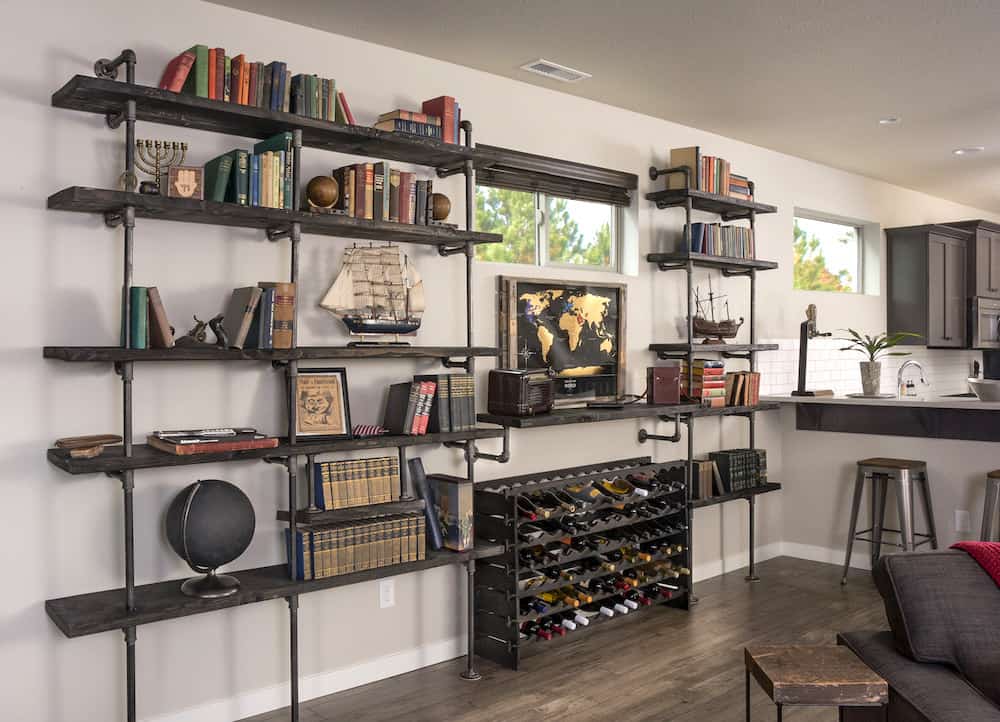
If you’ve priced industrial pipe shelving lately, you already know it isn’t cheap. A single bookshelf can cost hundreds of dollars—and a full wall of shelving can easily run into the thousands.
That’s exactly why I was so impressed when I walked into my neighbor’s house and saw this DIY pipe shelving. It stretched across an entire wall, looked like something from a high-end furniture store, and I immediately assumed he’d spent a fortune.
Nope.
He built the whole thing himself over the course of a weekend for around $350. Note – this was the original price he built it for. With cost increases, it’s about $475 now.
Even better? Once he showed me how everything fit together, I realized this project is much more approachable than it looks. If you can drill a few holes, stain wood, and screw pipe fittings together, you can absolutely build these shelves.
I’ll walk you through the entire process—including where to buy affordable pipe, how to customize the dimensions for your space, and a few lessons learned that will save you time (and help you avoid wasting a board or two).
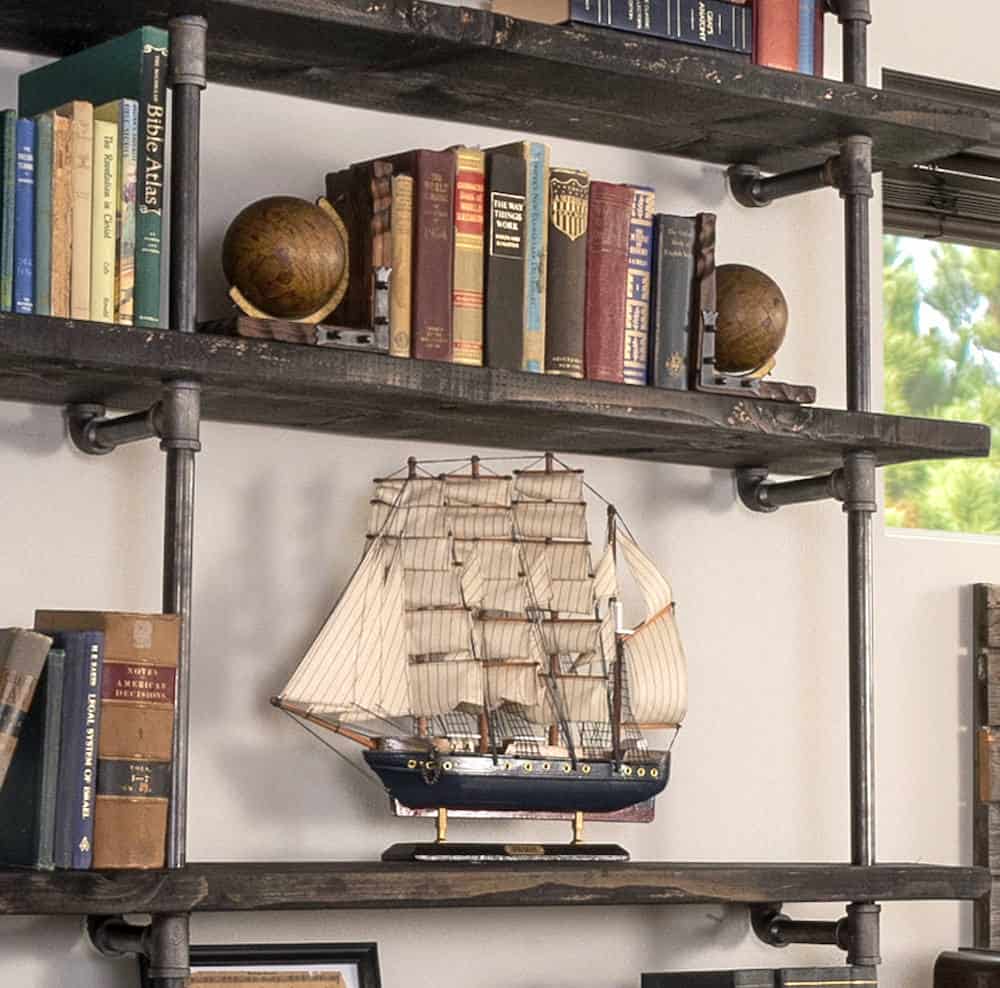
Industrial Pipe Shelves
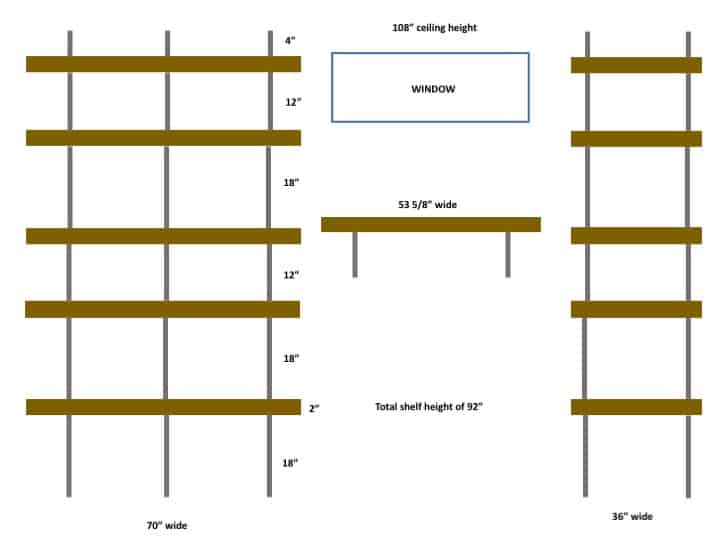
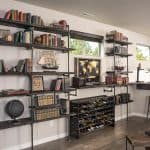
This industrial pipe shelving is made up of three separate sections:
- Left shelving unit: five shelves, 70 inches long
- Center shelf: one shelf, 53 5/8 inches long
- Right shelving unit: five shelves, 36 inches long
Each shelf is approximately 11 inches deep, but the dimensions can easily be adjusted to fit your wall.
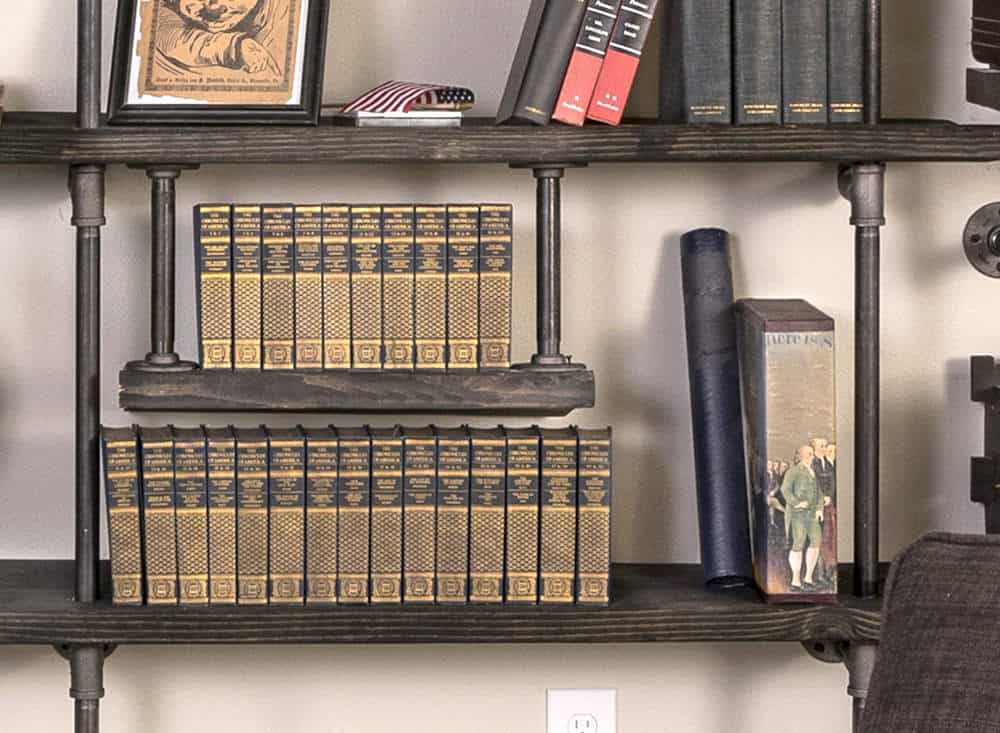
One of my favorite parts of this design is that the wood shelves are only attached to the wall at the very top using floor flanges. That means no drilling into your floor while still ending up with an incredibly sturdy bookshelf.
Planning Your Pipe Shelving DIY Project
Before buying a single piece of pipe or wood, spend a few minutes planning your layout.
If you’re building a simple shelf, this step isn’t critical. But for full wall wood shelves like this one, a quick sketch can save you from expensive mistakes.
Take a photo of your wall and pencil sketch your shelving over it. You can even use PowerPoint, Canva, or graph paper—whatever you’re comfortable with. Your drawing should help you answer a few simple questions:
- Will the shelves fit the wall?
- Will they fit around windows or trim?
- Are they tall enough for books or décor?
- How much wood and pipe do you actually need?
You don’t need architectural drawings—just a simple plan before you head to the store or purchase online.
A Quick Note About Pipe Sizes
Black pipe fittings can be a little confusing because the labeled size isn’t the same as the actual outside diameter.
As long as every fitting you buy is labeled 3/4-inch, they’ll all work together—even though the outside diameter is larger than 3/4 inch. Refer to this chart.
Always double-check that every flange, tee, elbow, and pipe nipple is the same labeled size before you leave the store.
Where to Buy Pipe
Pipe is easily the most expensive part of this project, so shopping around is worth it.
For a large shelving unit like this one, I recommend ordering from Supply House or checking a local plumbing supply store. Prices are often 50–75% lower than what you’ll find at the big-box home improvement stores.
If you’re only building one small shelf, buying everything locally may make more sense once you factor in shipping.
One more tip: black iron pipe usually arrives coated with a light layer of oil from the manufacturing process. Before assembly, wipe every piece down with a degreaser or mineral spirits so your shelves don’t end up with greasy fingerprints.
Here’s what was purchased:
Left Shelving Unit, 70″ long
- Pine boards, 2 x 12, 6 feet long – 5
- 3/4″ black floor flange – 6
- 3/4″ black elbow – 18
- 3/4″ black tee – 15
- 3/4″ 4″ black nipple – 3
- 3/4″ 6″ black nipple – 18
- 3/4″ 12″ black nipple – 6
- 3/4″ 18″ black nipple – 9
Middle Shelf, 53 5/8″ long
- Pine board, 2″ x 12″ x 6′, cut to fit the space
- 3/4″ black floor flange – 4
- 3/4″ black elbow – 2
- 3/4″ 6″ black nipple – 4
Right Shelving Unit, 36″ long
- Pine boards, 2 x 12, 3 feet long – 5
- 3/4″ black floor flange – 4
- 3/4″ black elbow – 12
- 3/4″ black tee – 10
- 3/4″ 4″ black nipple – 2
- 3/4″ 6″ black nipple – 12
- 3/4″ 12″ black nipple – 4
- 3/4″ 18″ black nipple – 6
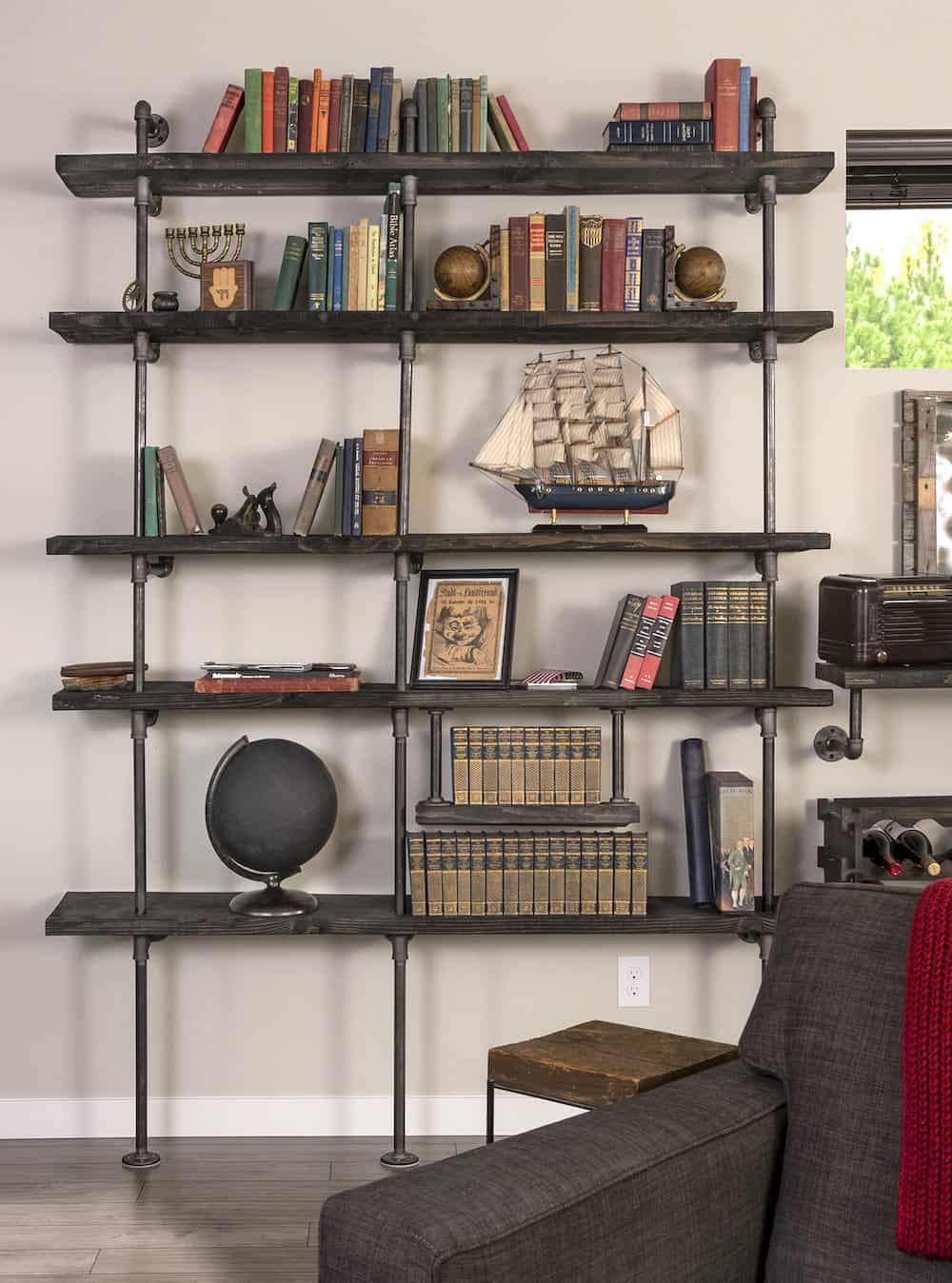
Choosing the Lumber
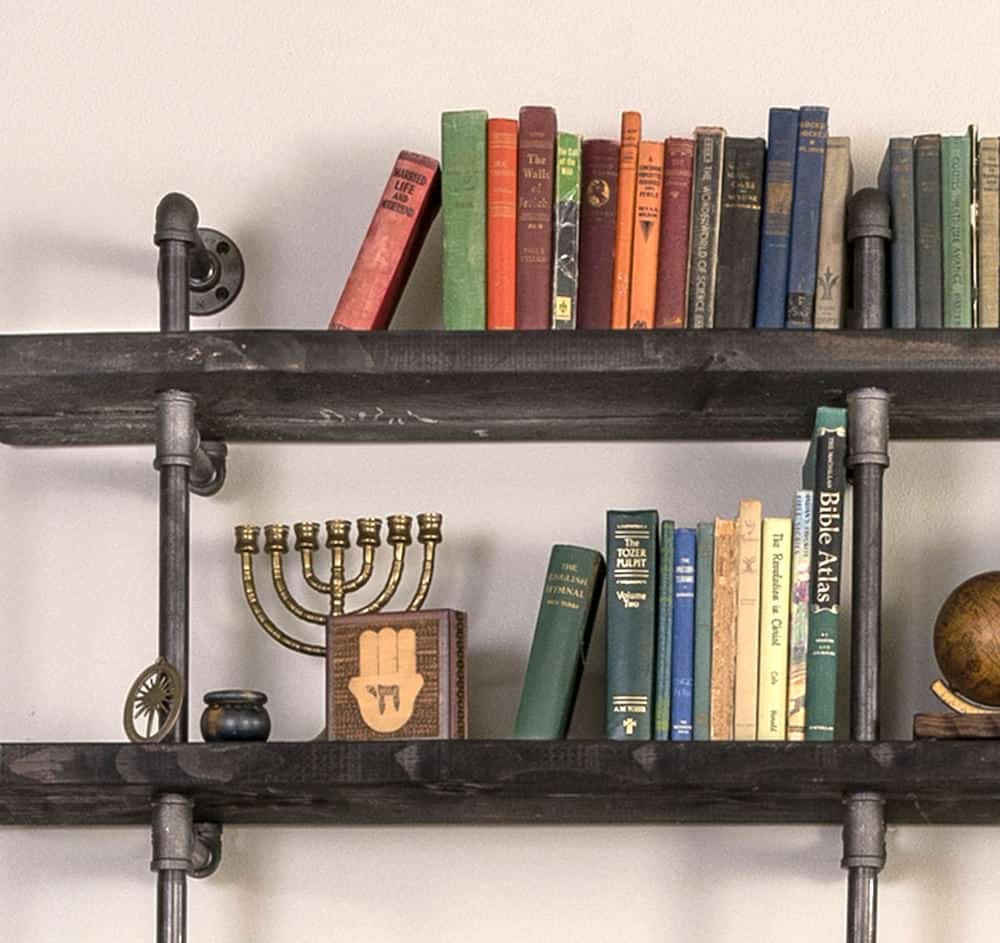
Pine is an excellent lumber choice for this project because it’s affordable, easy to work with, and takes stain beautifully. The ebony and carbon gray stain combination gives inexpensive pine a rich, reclaimed look without the reclaimed wood price tag.
If you’d rather have a smoother, more furniture-quality finish, you can upgrade to hardwoods like poplar or oak. They’ll cost more, but they’ll also resist dents a little better.
If you don’t own a table saw, don’t let that stop you. Most home improvement stores will cut lumber to length before you take them home.

Is This Pipe Shelving Stable?
Yes—when properly assembled and anchored to the wall with the right hardware, this shelving is extremely sturdy.
For most homes, securing the top flanges to the wall is enough. However, if you live in an earthquake-prone area or simply want additional stability, you can add extra flanges along the back of the shelving and fasten those to the wall as well.
If you have young children who may be tempted to climb on the shelves, additional wall anchors are also a smart idea.
No matter how you install it, remember that shelving is designed to hold books and décor—not people.
Can You Make It Freestanding?
Yes—but you’ll need to modify the design.
Instead of relying on the wall for support, you’ll need matching pipe uprights on both the front and back of the shelves connected across the top. Because a freestanding unit doesn’t have the wall helping to stabilize it, I also recommend making it shorter—two or three shelves is a much safer height.
If you’re planning a freestanding version, drill matching holes at both the front and back of every shelf so the pipe can pass through both sides.
Ready to get started? Here are the instructions!
DIY Industrial Pipe Shelving
Equipment
- Table Saw optional if your lumber is cut at the store
- Drill with drill bits including a 1 1/8″ Spade Bit
- Level
- Ladder
- Clean rags
- Paintbrush(es) or foam applicators
Materials
- Pine boards see the Notes section
- 3/4-inch black iron pipe and fittings see the Notes section
- 20 Drywall anchors and screws unless you are going into studs (then get wood screws)
- Degreaser or mineral spirits
- Minwax wood finish we used Ebony 2718 and Gray 271
- Polyurethane water based
- Painter’s tape
Video
Instructions
- Cut the shelves to size using a table saw. See the notes for cut lengths.
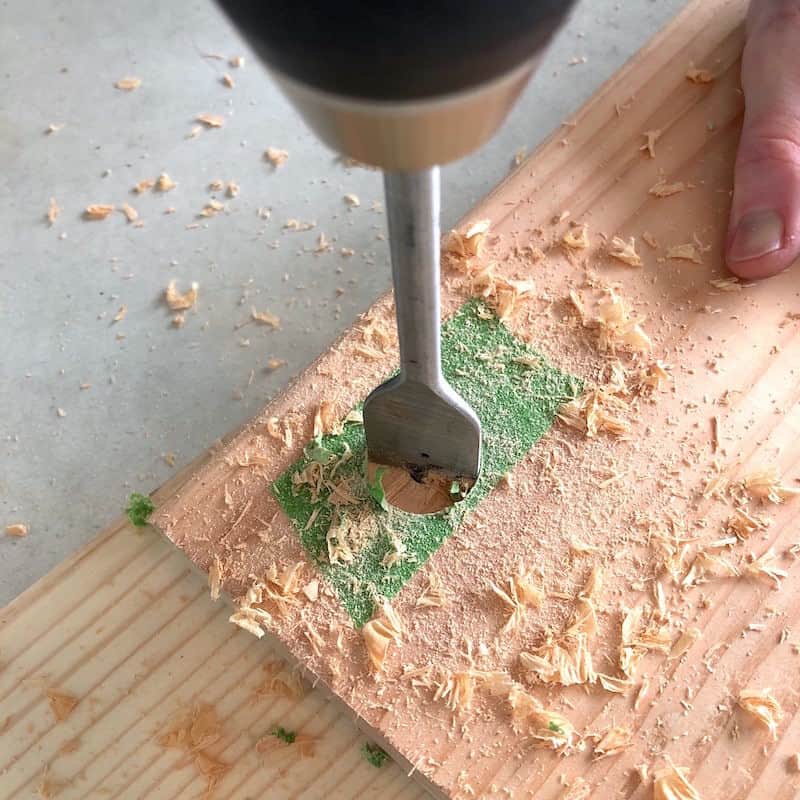
- Using your 1 1/8" spade bit, you're going to drill three holes through each 70" board and two holes through each 36" board. Your holes need to be in the same place on every 70" board and the same place on every 36" board since you are stacking them.
- Sand all surfaces until smooth.
- Apply Ebony stain and allow it to dry. Lightly add Carbon Gray in random areas for a weathered, reclaimed appearance.
- Once the stain is dry, apply two or three coats of water-based polyurethane. Allow the finish to cure completely.
- Clean every pipe fitting with a degreaser or mineral spirits to remove the factory oil coating.
- Assemble the pipe sections by connecting the pipe, tee fittings, elbows, and flanges before stacking the shelves.
- Beginning at the bottom, slide each shelf onto the pipe assembly and continue stacking until the unit is complete.
- Level the shelving and secure the top flanges to the wall using appropriate screws. Whenever possible, mount directly into a stud for maximum strength.
Notes
- Pine boards, 2 x 12, 6 feet long – 5
- 3/4″ black floor flange – 6
- 3/4″ black elbow – 18
- 3/4″ black tee – 15
- 3/4″ 4″ black nipple – 3
- 3/4″ 6″ black nipple – 18
- 3/4″ 12″ black nipple – 6
- 3/4″ 18″ black nipple – 9
- Pine board, 2″ x 12″ x 6′, cut to fit the space
- 3/4″ black floor flange – 4
- 3/4″ black elbow – 2
- 3/4″ 6″ black nipple – 4
- Pine boards, 2 x 12, 3 feet long – 5
- 3/4″ black floor flange – 4
- 3/4″ black elbow – 12
- 3/4″ black tee – 10
- 3/4″ 4″ black nipple – 2
- 3/4″ 6″ black nipple – 12
- 3/4″ 12″ black nipple – 4
- 3/4″ 18″ black nipple – 6
How much weight can these shelves hold?
Weight capacity depends on the shelf length, pipe configuration, wood species, and how securely the unit is anchored. Properly installed into wall studs, these shelves easily support books, baskets, and typical home décor. If you plan to store especially heavy items, shorten the shelf spans and anchor into a stud.
Can I drill the holes farther back to eliminate the rear supports?
No. The rear elbow fittings are part of what keeps the shelves level and stable. Moving the holes alone won’t eliminate the need for those supports without redesigning the entire pipe layout.
Can I customize the shelf lengths?
Absolutely! This design scales very well. Simply adjust your board lengths and pipe quantities to fit your space while keeping the hole placement consistent on matching shelves.
Let me know what you think in the comments! Here are some additional DIYs to check out:
Square Coffee Table • Coffee Table with Storage • Hose Holder and Planter • Lack Endtable Hack • Mirror Frame • Modern Headboard • Nolmyra Chair Hack • Outdoor Bench • Outdoor Table • Pallet Shelf • Platform Bed • Stacked Entry Bench • DIY Laminate Table Top • TV Riser • Wood Sign • Wood Step Stool Chair




I am in the midst of this project and found that the 6” nipple fits well across the width of the shelves when it is connected between the Tee and the Elbow in the shelf “supports”; however at the top of the structure, where it is connected between the Tee and the Flange, the same length of pipe will not work as the “depth” of the flange is not as great as the elbow. In other words, the flange is a relatively flat fitting while the elbow is not, so the distance from that fitting to the tee at the front edge is different. I’m going to need to order some additional nipples for the top that are slightly longer, probably 7-8”.
Also, the pipe from Supply House arrives heavily greased to protect it from rust. Unfortunately, that won’t do when you’re using it for a home furnishing. So one should plan on a day or so of degreasing (acetone worked best for me) and then rust-proofing (I used paste wax but a spray on Rust-Oleum product would work well too).
Curious what length nipple you ended up using for the top connection to the flange. I will also be using this length to connect a flange somewhere in the middle of the wall to add some additional support (little kids).
Appreciate your help on this.
Thanks,
I used 7” nipples at the top and that worked. I measured the ideal size would be something custom cut like 7 1/4” but I just used the 7 and didn’t thread it all the way at either end and it worked fine.
@Ryan Kowalski, this is a great source to show the cleaning process.
https://www.youtube.com/watch?v=7bReWtdBtkA
This is an amazing design! Thanks for sharing, especially all the details. It really balances costs, effort and beauty. Everyone loves it and it is tempting to continue building in this style around the room.
https://www.instagram.com/p/BvZcPgpnon-/
BTW – I purchased my pipe parts here https://rustydesignusa.com/collections/pipe-kits
One question: the middle supports do not come into contact with the shelves. It doesn’t seem to matter much in terms of support. My shelves were not perfectly straight, and the shelf would only rest on two of the supports at a time. Any other suggestions?
@Jonah, If I’m understanding you correctly it sounds like your shelve may be bowed a bit from the front of your shelve to the back. Take a look at your shelve from one end and is it curved up a bit? If it is and it’s enough that it bothers you, you may have to cut a new shelf piece or if you have access to a planer you can plane it flat. Please write me back if I have failed to identify the problem correctly. Thank you for commenting!
I want to build this to hold scrapbooking supplies. The supplies can get very heavy. With support only at the top will this hold much weight?
Hi there – I looked up a shelf that was similar (pre-made) and it attaches the same way. The weight limit was 15 lb per shelf, which seems reasonable to me! Of course, it depends on several factors, so I’d do 5 lb, then 10 lb, etc. and make sure. Slowly load it up rather than doing it all at once.
Hello- in some of the pictures the pipe looks black or antiqued, in another it looks more silver. Was there a treatment applied to make the shiny/new look “aged”?
I’ve made some shelving fixtures for customers from “black” iron pipe and we were surprised that the threads are always longer than the flanges, leaving exposed threads which we didn’t account for, aesthetically, plus they are sharp! so we had to sand them down to make them safer for retail usage. In our experience, the Pipe was very expensive and there’s not a lot of variety in vendors where we are. I look forward to trying your suggested supplier! thank you for sharing.
Hi Mike! There wasn’t a treatment applied – the pipe just arrived that way! It does have some silver areas in person; but also my husband is a photographer and used lighting to take the photo, so that may cause a different look. I will say I was impressed with Supply House. There weren’t many sharp edges if any and the pipe looked good. 🙂
Hi,
Love this and planning mine now. Questions:
1. Beginning of article you say build from top to bottom, but later on, you say add shelves going upward. So do you start at top and work down or at floor and work up?
2. If you start at floor, is the unit standing upright as you build? If so how are you holding it all up since not connected to floor or wall yet. Or is it being assembled on the ground lying flat and then stood upright to attach?
I’ll be doing this mostly alone, so trying to figure out the logistics. Thanks.
Hi Renee!
1) I changed it, you’re right! I meant bottom to top.
2) You can start to lean it against the wall as you assemble it (be careful) and it will kind of stand up on its own (but don’t just leave it standing there). It’s best if you can have two people for the assembly, but if you have to do it alone, I don’t recommend laying it down. It’ll be too heavy to lift!
Where did you find the wine cabinet?
It’s from IKEA!
Hi Amy, I love this book shelf and made a slightly modified version to serve as a 5-tier shoe shelf yesterday. One thing I did realize is that the beginning of your article mentions a 1 1/2″ spade bit and the article later references a 1″ bit. I actually found that a 1 1/4″ bit is perfect and a 1″ was too small for 3/4″ pipe in my case. I also think I will need an 8″ nipple for the top wall anchor, as the 6″ with my floor flanges is quite short. Great instructions and super easy, fun project! Thanks for sharing!
Good catch Rachel! We did use a 1 1/2″ spade so I revised it. Thank you so much for reading!!
@Rachel, I am building a version of these shelves and 1 1/2 is too big of a hole for the fittings. 1 1/4 seems to be right.
Love this shelf. I am in the process of trying to figure this basic shelf out for my bar area. You did an awesome job!!!!
Hey Amy, I love this bookshelf your neighbor made and the weathered look it has to it. I have introduced a new product in the last two years named SteelTek that encompasses the industrial look and style without the threaded ends. I would love to see what you can do with our products!
These shelves look great, and I love that they are at varying heights for interest. The “hanging” shelf section on the lower left is perfect to display that set of books. Thanks for sharing the source for cheaper pipe parts. That can really add up and saving over $1.20 per flange will make it more affordable. It looks great with your floors too!